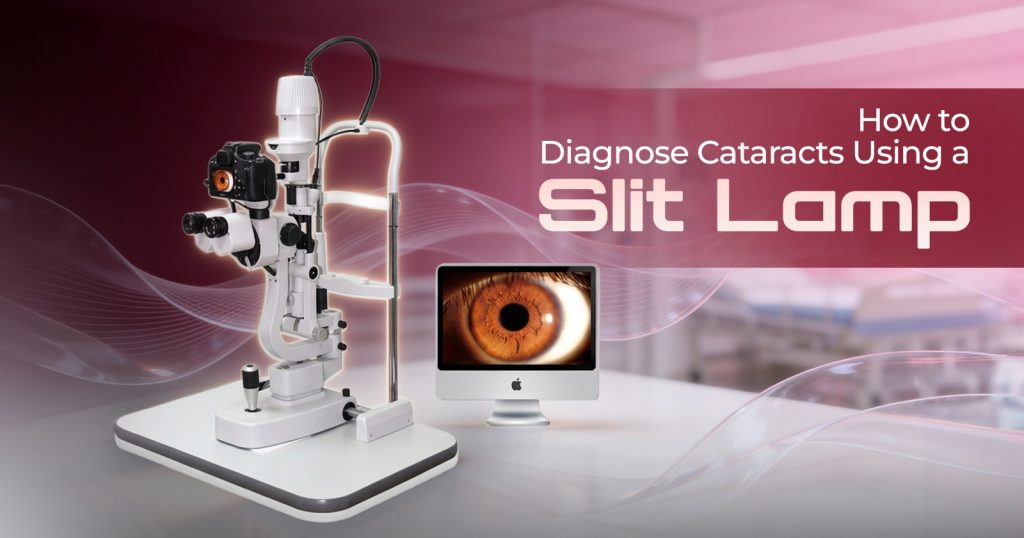
To diagnose cataracts using a slit lamp, clinicians must perform a systematic biomicroscopy evaluation. The examination involves diffuse illumination, optical sectioning for nuclear density, and retro-illumination to detect cortical and posterior subcapsular opacities. As the leading cause of reversible blindness worldwide, early and accurate cataract identification is the cornerstone of preserving vision and planning surgical intervention. The slit lamp biomicroscope remains the gold standard for this evaluation, offering unmatched magnification, illumination control, and lens detail.
Steps for Slit Lamp Cataract Diagnosis
The four examination phases of cataract diagnosis with the slit lamp include:
- Patient preparation: Dilate the pupil with tropicamide 1% for complete visualisation of the lens
- Diffuse Illumination: Work at a low magnification and a large aperture to determine the overall clarity of the lens.
- Use Focal Beam Technique: Train the beam to go into a narrow portion of the field for nuclear grading and layer analysis.
- Retroillumination: Use the fundus reflex to reveal posterior subcapsular and cortical opacities.
How to use your slit lamp
The slit lamp setup procedure is as follows:
- Rest the patient’s head so that the chin rests on the rest and the forehead rests on the strap.
- Centre the slit lamp beam on the patient’s eye height. Look at it in low-light conditions to obtain contrast. Start at 10× and then up to 16× or 25× for detailed grading.
Different Types of Cataracts Identified on Slit Lamp
The table given below shows the various types of cataract which have been the subject of examination using a slit lamp:
| Cataract Type | Slit Lamp Appearance | Common Cause |
| Nuclear Sclerotic | Yellow-brown opacity in lens nucleus; visible on optical section | Age-related; most common |
| Cortical | Wedge-shaped or spoke-like opacities radiating from the periphery. | Diabetes, UV exposure |
| Posterior Subcapsular | Plaque-like opacity at the posterior pole; best seen on retroillumination | Steroids, trauma, uveitis |
| Anterior Subcapsular | Opacity just beneath the anterior capsule | Trauma, atopic disease |
How Is Cataract Diagnosis Graded Using the LOCS III System?
Lens Opacities Classification System III (LOCS III) is the most commonly used system in the world. Determines a grade for nuclear opalescence (NO), nuclear colour (NC), cortical cataract (C), and posterior subcapsular cataract (P) on standardised photographic scales. Ophthalmologists make a direct comparison with reference photographs, ensuring a reproducible grade, which is noted for making surgical decisions and recording for research.
How to Choose the High-Quality Slit Lamp Suppliers for Your Practice?
The given below are the key elements that you need to focus on before choosing a slit lamp supplier:
- Optical Quality: True colour rendering requires high-resolution Haag-Streit optics and anti-reflective coating with minimal chromatic aberration.
- Illumination System: LED illumination is now preferred over halogen as it is consistent in colour temperature and for its extended life and reduced heat output in long examinations.
- Certification/Standards: Choose the supplier who offers a CE-marked or FDA-cleared instrument, backed up with full documentation and after-sales technical support.
- Digital Integration: Today’s slit lamp manufacturers provide camera-ready slit lamps with slit lamp adapters for photo documentation, which is essential in monitoring progression.
Want to Opt for the Best Slit Lamp for Your Patients?
Slit lamp is a science and a craft for diagnosing cataracts. Understanding and use of diffuse illumination, optical sectioning and retroillumination, in conjunction with the use of standardised grading (LOCS III). These all allow ophthalmologists to confidently identify even early changes in the lens. With trustworthy slit lamp suppliers, this diagnosis becomes an effective and repeatable clinical tool that helps to save the patient’s sight and maintain records. So, always invest in the right equipment, get to know it and use every slit lamp session to its full capacity.